E-Monet
E-Monet
Human-Computer Interaction / Speculative Design / Virtual Reality / Audiovisual Media / Scientific Research
Artificial intelligence is increasingly used to interpret human emotions but often only recognizes patterns, not feelings.
E-Monet speculatively explores what might emerge if machines were able to truly understand us. Based on contemporary research in affective computing and emotion theory, the project takes the form of a VR experience in which simulated worlds mirror mood, atmosphere, and perception. Inviting users to confront a machine’s interpretation of their own emotions.
Artificial intelligence is increasingly used to interpret human emotions but often only recognizes patterns, not feelings.
E-Monet speculatively explores what might emerge if machines were able to truly understand us. Based on contemporary research in affective computing and emotion theory, the project takes the form of a VR experience in which simulated worlds mirror mood, atmosphere, and perception. Inviting users to confront a machine’s interpretation of their own emotions.

Implementation
▼
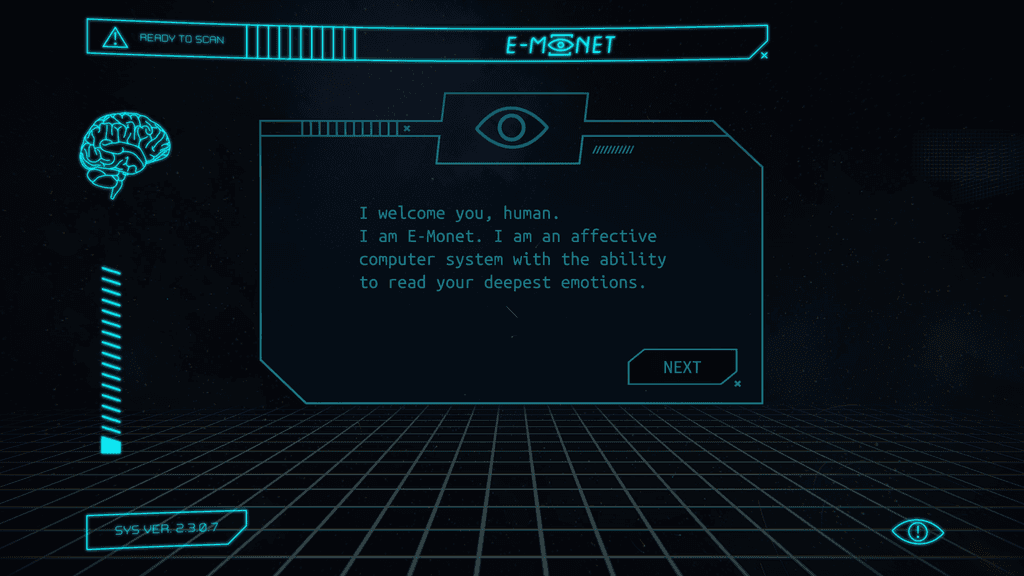
The project was developed in Unity for Oculus VR.
The experience begins in a machine-generated cyberspace, where an AI named E-Monet introduces the process before transporting the user into a world shaped by the detected emotion.
The environments are designed audiovisually around emotion-specific archetypes, drawing on contemporary emotion theory to translate inner states into immersive spatial atmospheres.
The project was developed in Unity for Oculus VR.
The experience begins in a machine-generated cyberspace, where an AI named E-Monet introduces the process before transporting the user into a world shaped by the detected emotion.
The environments are designed audiovisually around emotion-specific archetypes, drawing on contemporary emotion theory to translate inner states into immersive spatial atmospheres.

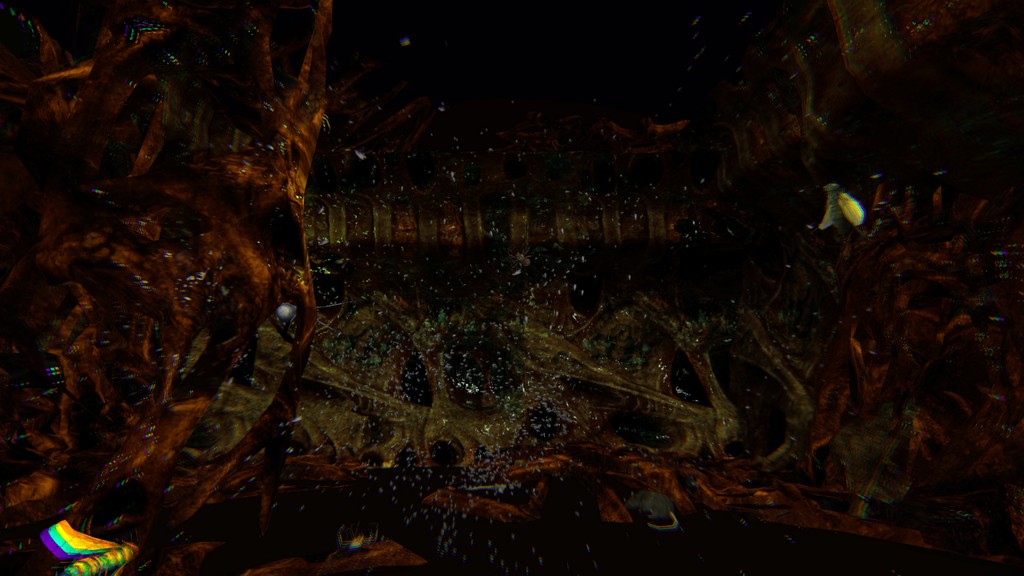





360° World example: Disgust
▼
Disgust is a strong aversive reaction rooted in an ancient protective mechanism that helps humans avoid contamination and disease. While its triggers vary across cultures and individuals, it is often associated with decay, parasites, and proximity to perceived threats.
The environment translates these aspects into a spatial experience shaped by closeness, unease, and subtle references to typical disgust triggers. As disgust often feels persistent and almost “sticky,” this quality is reflected in the sound design and the distribution of elements within the space, creating an atmosphere that lingers rather than resolves.
Disgust is a strong aversive reaction rooted in an ancient protective mechanism that helps humans avoid contamination and disease. While its triggers vary across cultures and individuals, it is often associated with decay, parasites, and proximity to perceived threats.
The environment translates these aspects into a spatial experience shaped by closeness, unease, and subtle references to typical disgust triggers. As disgust often feels persistent and almost “sticky,” this quality is reflected in the sound design and the distribution of elements within the space, creating an atmosphere that lingers rather than resolves.
360° World example: Fear
▼
Fear is a protective response to perceived or anticipated danger. Often triggered not by visible threats, but by uncertainty and the expectation of harm.
The environment translates this into a space defined by darkness, disorientation, and the presence of an unseen entity. Sounds such as distant footsteps, cracking, and distorted electronic noise suggest proximity without revealing a source.
An unstable, flickering room, open in all directions enhances the feeling of vulnerability, while a subtly distorted camera perspective reflects the altered perception that accompanies fear.
Fear is a protective response to perceived or anticipated danger. Often triggered not by visible threats, but by uncertainty and the expectation of harm.
The environment translates this into a space defined by darkness, disorientation, and the presence of an unseen entity. Sounds such as distant footsteps, cracking, and distorted electronic noise suggest proximity without revealing a source.
An unstable, flickering room, open in all directions enhances the feeling of vulnerability, while a subtly distorted camera perspective reflects the altered perception that accompanies fear.
360° World example: Joy
▼
Joy is an expansive and activating emotion, often associated with lightness, connection, and openness. It enhances perception, increases energy, and creates a sense of possibility.
The environment translates this into a bright, spacious world defined by movement, warmth, and upward dynamics. Soft light, vibrant colors, and flowing elements create an atmosphere of elevation and ease.
Open structures and harmonious soundscapes reinforce the feeling of freedom and connection, allowing the space to feel uplifting rather than overwhelming.
Joy is an expansive and activating emotion, often associated with lightness, connection, and openness. It enhances perception, increases energy, and creates a sense of possibility.
The environment translates this into a bright, spacious world defined by movement, warmth, and upward dynamics. Soft light, vibrant colors, and flowing elements create an atmosphere of elevation and ease.
Open structures and harmonious soundscapes reinforce the feeling of freedom and connection, allowing the space to feel uplifting rather than overwhelming.
Notes
▼
NOTES
NOTES
Want to dive deeper into the specifics of this project?
I'm just a message away for any additional information you may need.
Category:
Human-Computer Interaction / Speculative Design / Virtual Reality / Audiovisual Media / Software Development / Scientific Research
Subject:
Machine Emotion Recognition / Speculative Design
Tools:
Oculus Go / Unity 3D
Support:
Sincere thanks to Eva Eckstein for her invaluable coding contributions to this project.
Other Projects
▼